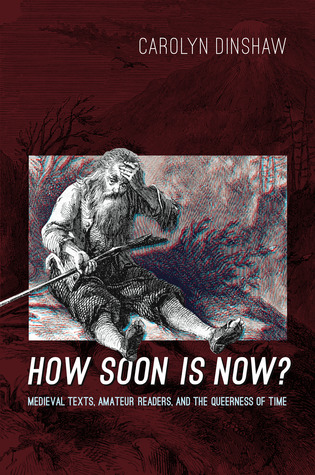
How Soon Is Now?: Medieval Texts, Amateur Readers, and the Queerness of Time
Est. 4h 22m
299 Pages
299 reading now
Prologue
How Soon Is Now? performs a powerful critique of modernist temporal regimes through its revelatory exploration of queer ways of being in time and the potential queerness of time itself. Carolyn Dinshaw focuses on medieval tales of asynchrony and on engagements with these medieval temporal worlds by amateur readers centuries later. In doing so, she illuminates forms of desirous, embodied being that are out of sync with ordinarily linear measurements of everyday life, that involve multiple temporalities, that precipitate out of time altogether. Dinshaw claims the possibility of a fuller, denser, more crowded now that theorists tell us is extant but that often eludes our temporal grasp.Whether discussing Victorian men of letters who parodied the Book of John Mandeville, a fictionalized fourteenth-century travel narrative, or Hope Emily Allen, modern coeditor of the early-fifteenth-century Book of Margery Kempe, Dinshaw argues that these and other medievalists outside the academy inhabit different temporalities than modern professionals operating according to the clock. How Soon Is Now? clears space for amateurs, hobbyists, and dabblers who approach medieval worlds from positions of affect and attachment, from desires to build other kinds of worlds. Unruly, untimely, they urge us toward a disorderly and asynchronous collective.Carolyn Dinshaw is Professor of English, and Social and Cultural Analysis at New York University. She is the author of Getting Medieval: Sexualities and Communities, Pre- and Postmodern, also published by Duke University Press, and Chaucer's Sexual Poetics. Dinshaw is a founding coeditor of GLQ: A Journal of Lesbian and Gay Studies."Entering into an elegant slipstream of generative, generous, rigorous thought, Carolyn Dinshaw proves again her exquisite power to enchant her readers. Uniquely attractive as a theorist of time, she brilliantly addresses a temporal spread, from the seeming irrationality of medieval temporality to modernity's 'stingy' outlook on the senses. As I read How Soon Is Now? I found her signal emphases—reading, temporality, non-linearity, queer historicity, and medieval mysticism—mattering to me, a queer theorist and non-medievalist, in the novel ways she said they would."—Kathryn Bond Stockton, author of The Queer Child, or Growing Sideways in the Twentieth Century"How do queers relate to the distant past and experience time? Carolyn Dinshaw’s answer to this question in How Soon is Now? ranges through astute literary criticism, cogently argued theory, and snippets of autobiography. The result is a provocative essay about the value and presence of the past that is also at times profoundly moving. Her account of the amateur scholar’s privileged relation to asynchrony and affective engagement with the object of study should give all in the academy pause for thought."—Simon Gaunt, author of Love and Death in Medieval French and Occitan Courtly Literature: Martyrs to Love"Carolyn Dinshaw writes with love, learning, and endless good humor about asynchrony, the amateur, and the complex queerness of both. How Soon Is Now? is full of asynchrony stories, both medieval and modern, stories in which time is out of joint or so full as to be irresolvable into the narrowly sequential conception of time that remains one of the driving engines of the heteronormative imagination. Rather than rejecting the past or the future, Dinshaw argues for the asynchrony of a now in which the very distinction between past, present, and future becomes impossible to make. In a series of beautiful and moving readings, Dinshaw makes us think about what we love. 'I want more life.' Who can argue with that simple but extraordinary claim?"—Amy Hollywood, author of Sensible Ecstasy: Mysticism, Sexual Difference, and the Demands of History