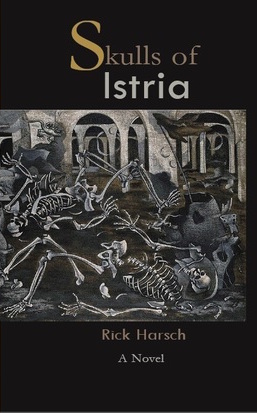
Skulls of Istria
Est. 8h 10m
152 Pages
337 reading now
Prologue
A man sits at a bar in Piran on the Adriatic coast in former Yugoslavia and tells his story to a large man who speaks no English, yet plied by free liquor remains, at times in a drunken sleep, head on the table as the words drift over his skull. This tavern confession is told by a defrocked historian from the United States, who unwittingly, perhaps naively, brought his talents to the turmoil of the Balkans. His tales in the first chapter take us to Capodistria, Ancona, Venice, and back to the bar where we began, linked by the physical presence of a wind known as the Burja (the Italian bora), a great wind capable of lifting cars into the air. But the unnamed narrator is not simply telling random stories. As we move through the next four chapters, we realize that this book is indeed confessional, an apology of sorts, yet with a broken man’s defiance; it is a meditation not only about hats and a historian’s attempt at written redemption, but about love and politics, history and warriors who drink blood, the isolation of a stranger in a strange land and the choices that lead us to death and our inability to use language to transcend ourselves – a paradox, as the language does indeed transcend, not as poetry transcends, but as exceptionally precise prose armed with irony, with philosophical insight, transcends. But I must do better than that when trying to describe the impact of the prose! There are passages throughout that possess a Joycean verbal inventiveness, emotionally charged language and unsettling images that force the reader to capitulate to a vision of reality that resonates with a beauty we rarely glimpse, and a truth that of necessity must expand our notion of whatever reality we think we inhabit. As example: “You look at me in that aggressive quid pro Balkan way, sizing me up by what you take to be elemental mammalian factors — how much can he drink, how long can he hold a live and kicking sheep over his head, how many Turkish boys will he rape, how long can he stare into the squidless Adriatic ink with his miner’s helmet and not see himself, what fair widow could make tender his heart—but you don’t see all the dimensions available to you, you don’t see a past. An admirable blindness, I grant you, to be envied. Whereas a trained historian such as myself sits next to you and I can smell your past like the placenta from a birth of pigs rotting in the sun. I can’t look at you and avoid your past.” In short, the tales in the first chapter and those that follow, in particular an eponymous episode that captures the horror of the Balkan war through historic mayhem, with an echo of both Hamlet and Breughel, are all lost in the trail of a Burja, that great wind which is like a cleansing of the soul. And that is in the end what Skulls of Istria is – a cleansing of the soul, comparable to similar novels such as Camus’ The Fall, which it exceeds in artistry, and Antonio Lobo Antunes’ South of Nowhere, perhaps the only comparable book of its kind.