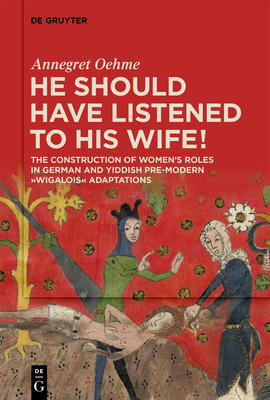
«He should have listened to his wife!»: The Construction of Women’s Roles in German and Yiddish Pre-modern 'Wigalois' Adaptations (De Gruyter Currents)
Est. 8h 11m
430 Pages
356 reading now
Prologue
This publication uncovers two previously dismissed pre-modern adaptations of the Middle High German Wigalois (1215) by exploring their different approaches to female agency in comparison with the original Wigalois, the Yiddish Viduvilt (14th ct.) and the German Wigoleis (15th ct.). Traditionally, scholarship often concentrated on the Yiddish text presenting female figures as behaving in a "Jewish manner" or embodying famous Jewish mythical figures such as Lilith (see Achim Jaeger / Robert G. Warnock). Rather than trying to argue for or against a figure's "Jewishness," I evaluate these interpretations from the perspective of Arthurian Literature by showing that the construction of female agency is at the center of all three adaptations of this important chapter of German-Jewish literature and culture.